
From Autonomous Driving to Autonomous Inspection: The Unseen Infrastructure Challenge Behind Robotaxi Scaling
Sep 20, 2026

Shanghai, China Sep 20, 2026 (Issuewire.com) - Tesla's Cybercab has brought the future of autonomous transportation back into the spotlight.
Unlike conventional vehicles, Cybercab is purpose-built for autonomous operation, with no steering wheel or pedals. Tesla has now begun offering Cybercab rides in limited areas of Austin, Texas, marking another step in the development of its Robotaxi service.
Most discussions naturally focus on the technology inside the vehicle: autonomous driving software, AI perception, vehicle design, safety, and the economics of driverless mobility.
But there is another question that deserves more attention:
What happens behind the scenes when autonomous vehicles begin operating at scale?
The answer may have less to do with the AI "brain" inside the vehicle--and more to do with the infrastructure supporting it.
The Part of the Robotaxi Revolution We Don't See
The commercial promise of a Robotaxi is relatively straightforward: maximize vehicle utilization by allowing the vehicle to operate for much longer periods without a human driver.
But higher utilization also means higher operational demands.
A privately owned vehicle might sit unused for most of the day. A Robotaxi fleet, by contrast, is designed to keep vehicles moving, transporting passengers and returning to operating areas repeatedly.
That creates a different fleet-management challenge.
Vehicles still need to be cleaned, charged, maintained and inspected. Tires still wear. Body panels can still be scratched or dented. Road debris can still cause damage. Components underneath the vehicle can still be exposed to impacts and harsh road conditions.
Autonomy changes how a vehicle drives.
It does not change the physical realities of operating a vehicle.
And this is where the industry's next infrastructure challenge may emerge.
When There Is No Driver, Who Monitors Vehicle Condition?
It is important to clarify what "driverless" actually means.
A driverless vehicle does not mean a vehicle without maintenance personnel, technicians or service facilities. An autonomous vehicle can still return to a depot or service center for maintenance and human inspection.
The issue is different:
Can traditional inspection processes keep pace with an increasingly automated fleet?
A human technician can walk around a vehicle, visually inspect its exterior and identify obvious problems. That approach can work well for individual vehicles or smaller fleets.
But as Robotaxi fleets expand, inspection becomes a recurring operational process.
Imagine a future depot where hundreds--or potentially thousands--of autonomous vehicles pass through every day.
-
How long should each inspection take?
-
How consistently can every vehicle be checked?
-
Can the inspection results be recorded automatically?
-
And, perhaps most importantly, can minor changes be detected before they become larger maintenance problems?
These questions point toward an emerging area of Automated Vehicle Inspection.
From Manual Walk-Arounds to Intelligent Inspection Gates
The traditional Vehicle Inspection model depends heavily on people.
A technician looks at the vehicle, checks selected components, records abnormalities and decides whether further maintenance is required.
The next generation of Robotaxi infrastructure could add another layer: automated inspection at the entrance or exit of a depot.
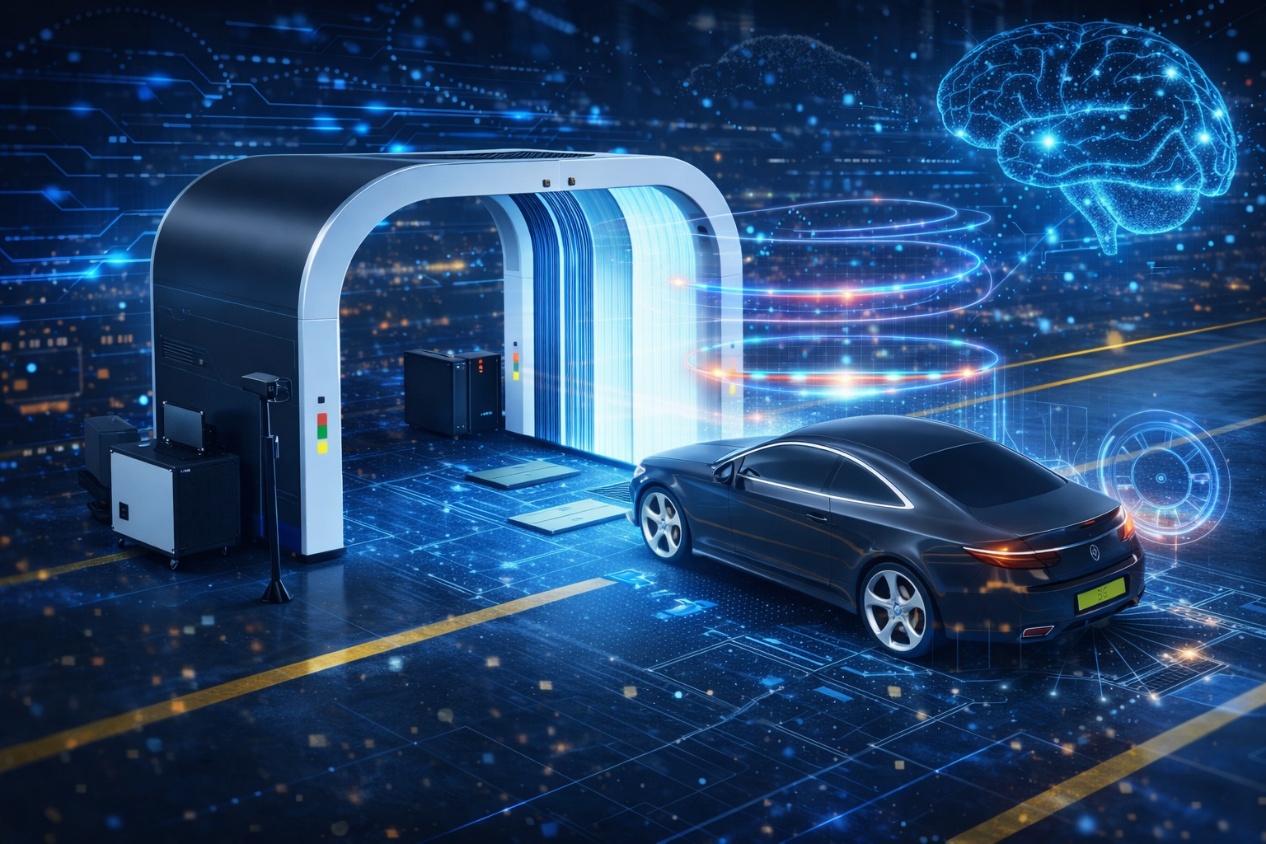
Instead of stopping a vehicle for a lengthy manual inspection, an Automated Vehicle Inspection system could scan the vehicle as it passes through a designated inspection area.
The concept is relatively simple.
The vehicle drives through.
Sensors and cameras capture its condition.
AI analyzes the collected data.
Potential abnormalities are identified.
Inspection results are stored for future reference.
This does not necessarily eliminate technicians. Instead, it can provide them with a more consistent and scalable way to monitor fleet condition.
What Could Automated Vehicle Inspection Look Like?
The technology behind an Automated Vehicle Inspection gateway could combine multiple inspection capabilities.
1.Automated Exterior Inspection
A vehicle body scanner could capture high-resolution images while the vehicle passes through the inspection zone.
AI-based image analysis could identify visible conditions such as scratches, dents, paint damage and missing or abnormal exterior components.
For a large Robotaxi fleet, creating a digital record of vehicle condition after repeated operating cycles could also help operators track changes over time.
2.Automated Tire Inspection
Tires are among the most frequently consumed components on any high-mileage vehicle.
For autonomous fleets, monitoring tread wear, uneven wear and other visible tire conditions could become an important part of routine fleet management.
Instead of relying solely on periodic manual checks, automated tire inspection could provide more frequent condition data as vehicles pass through the depot.
3.Underbody Inspection
The underside of a vehicle is one of the least visible areas during a conventional walk-around inspection.
Road debris, impacts, corrosion and fluid leakage may not always be immediately visible from the side of the vehicle.
An automated underbody scanning system could provide another layer of visibility, allowing operators to identify potential abnormalities without requiring technicians to physically inspect every vehicle underneath.
Together, these technologies point toward a broader concept: AI vehicle inspection as part of the depot itself.
Depot Automation Could Become the Next Layer of Robotaxi Infrastructure
The development of autonomous transportation is often described as a race to build better AI.
That is certainly important.
But commercial mobility is never just about the vehicle.
Airports need baggage systems. Logistics companies need warehouses. Electric vehicles need charging infrastructure. And autonomous fleets need efficient operational facilities.
Robotaxi infrastructure will likely evolve in the same way.
Charging can become automated.
Vehicle cleaning can become increasingly automated.
Fleet dispatch can be software-driven.
And Automated Vehicle Inspection could become another automated layer connecting these processes.
This does not mean every Robotaxi depot will immediately adopt fully automated inspection. The actual infrastructure model will depend on fleet size, operating conditions, regulations and business requirements.
But as autonomous fleets scale, the value of faster, repeatable and data-driven vehicle inspection is likely to become increasingly relevant.
The Future of Autonomy Is Bigger Than the Vehicle
Cybercab represents an important change in how we think about transportation: the vehicle itself is becoming increasingly autonomous.
But autonomy does not end when the vehicle arrives back at the depot.
The next question is what happens between rides.
How quickly can the vehicle be charged?
-
How efficiently can it be cleaned?
-
How accurately can its condition be monitored?
-
How quickly can potential problems be identified?
-
And how effectively can all of this information be connected to the vehicle's maintenance history?
These are not necessarily the most visible parts of the Robotaxi revolution.
But they could become critical to making autonomous fleets operationally scalable.
The public may continue to focus on the AI brain that allows a Cybercab to navigate a city.
From an industry perspective, however, there is another system worth watching:
the infrastructure that keeps that vehicle ready for its next ride.
The next stage of autonomous mobility may therefore involve more than autonomous driving.
It may also involve Automated Vehicle Inspection, intelligent fleet maintenance and increasingly automated depot operations.
The road to autonomous transportation may begin on the street--but its long-term scalability could depend just as much on what happens off the road.
Media Contact
New Tech Automotive Technology(Shanghai)Co., Ltd.
+86-17717670602
Source :New Tech Automotive Technology(Shanghai)Co., Ltd.
This article was originally published by IssueWire. Read the original article here.
More News











YOUR NEWS, OUR NETWORK.
Do you have Great News you want to tell the world?
Be it updates about your business or your community, you can make sure that it’s heard by submitting your story to our network reaching hundreds of news sites across 6 verticals.